Every startup faces the same early decision: how much to spend before you know if the idea works. A clear MVP budget protects both time and money. It helps you test traction fast without getting stuck in half-finished builds or expensive pivots. The goal is not to spend less but to spend purposefully.
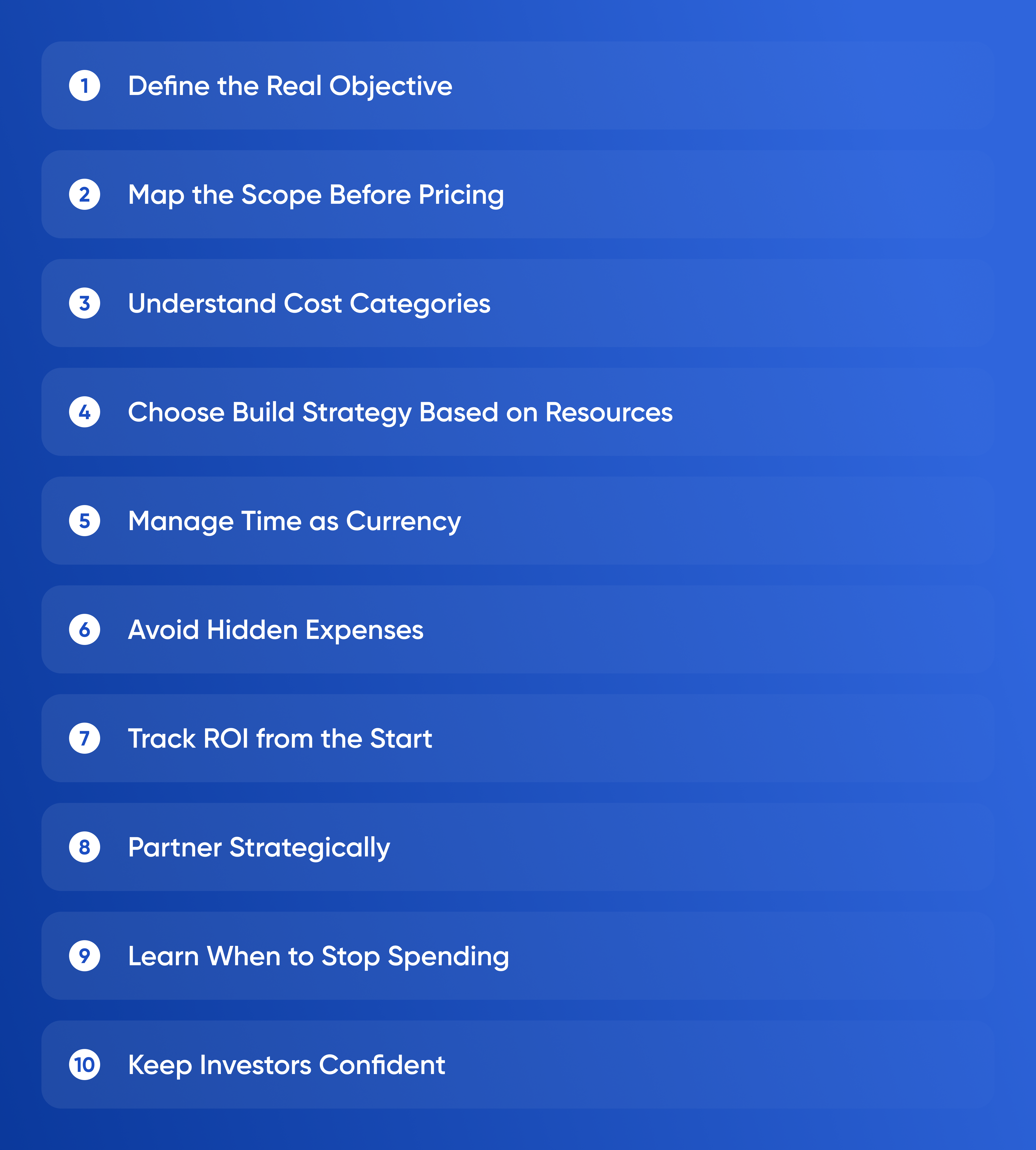
Define the Real Objective
An MVP budget is not just a number. It is a strategy. Decide what you must prove before you can raise or sell. For some founders that means confirming user demand. For others it means demonstrating technical feasibility. Each objective defines a different budget structure. A product built to test user behavior should invest in design and analytics. A product built to test performance should invest in backend engineering and load testing.
Clarity prevents waste. Without it, teams build everything halfway. The most efficient founders tie every dollar to a learning goal. When you know what the MVP must teach you, cost decisions become mechanical instead of emotional.
Map the Scope Before Pricing
Scope creep is the main cause of budget failure. Write one paragraph describing what the MVP will and will not do. Keep it simple and honest. For example, “the MVP lets users sign up, create a basic profile, and share one post per day” is clear. Anything outside that sentence belongs to the backlog.
This description becomes the backbone for estimating cost. Designers, engineers, and marketers can all align on that single job to be done. When new ideas appear, you can test them against the scope and decide if they truly belong.
Understand Cost Categories
Every MVP has four spending areas: product, team, tools, and launch. Product includes design, development, and testing. Team covers salaries or contractor fees. Tools include software, hosting, and integrations. Launch includes marketing, analytics, and customer support.
Each category deserves a rough ceiling. For most early stage software startups, product costs take sixty to seventy percent of the total budget. Team and tools share twenty to thirty percent. Launch can start small at ten percent, expanding once data confirms traction.
The exact ratios matter less than the discipline of tracking them. Simple spreadsheets beat complex systems at this stage. Record invoices weekly. Note which milestone each payment supports. The visibility alone saves money because it forces trade-offs.
Choose Build Strategy Based on Resources
If you have under twenty thousand dollars, use a lean strategy. Combine no-code components, design templates, and freelance help to test the concept in six weeks or less. The aim is speed to learning. If you have fifty thousand or more, you can hire a small dedicated team or work with a product studio to create a stable base for scaling.
Funding size also determines depth. A lean MVP might include one core flow and basic analytics. A larger budget can include polished UI, automated testing, and deployment pipelines. Match ambition to runway rather than ideal vision.
Manage Time as Currency
Money is not the only budget. Time is equally scarce. Create a three-phase schedule: discovery, build, and validation. Discovery covers research, user interviews, and wireframes. Build includes development and QA. Validation means launching to a small audience and collecting metrics. Each phase should have clear deliverables and deadlines.
A six- to eight-week total timeline keeps momentum without overextending. Deadlines force focus and help avoid endless feature additions. If the build slips, cut scope before adding time. Delayed MVPs rarely improve quality but always consume more energy.
Avoid Hidden Expenses
Hidden costs often appear in integrations, compliance, and hosting. Many founders forget about email services, push notifications, legal documents, or design assets. Add a small buffer, usually ten to fifteen percent, for unexpected expenses. This safety margin keeps stress low and decisions rational when new needs arise.
Track ROI from the Start
ROI for an MVP is not revenue. It is validated learning. Keep a simple table of hypotheses, metrics, and results. For example, “Users will create at least one post per week” is a measurable hypothesis. If your analytics show that only five percent of users post, the lesson is clear and valuable even if you spent ten thousand dollars to learn it. That learning prevents a hundred thousand dollars of future mistakes.
When you can measure learning, you can communicate progress to investors. It shifts the conversation from cost to traction. Every investor respects founders who treat budget as an experiment, not as vanity spending.
Partner Strategically
Working with an external product studio or contractor can save cost if you manage scope and communication. Choose partners who quote based on deliverables, not hours. Ask for examples of MVPs they built under similar constraints. A fixed price with milestone reviews prevents budget surprises. Keep ownership of design files, code, and analytics from day one. It ensures flexibility when you switch vendors or bring development in-house.
Learn When to Stop Spending
The hardest moment for a founder is deciding when enough is enough. Many MVPs die from one more feature. Define a clear finish line. It can be a number of users, a revenue target, or a date. Once you reach it, pause new spending until you review results. Sometimes the smartest financial decision is to stop, learn, and redirect.
Keep Investors Confident
Transparency builds trust. Share budget updates monthly. Include three numbers: total spent, remaining runway, and progress toward your learning goal. This habit reassures stakeholders and increases your chance of follow-on funding. It also keeps you honest with yourself.
Conclusion
An MVP budget is a reflection of clarity. Spend to learn, not to impress. Write your scope, allocate by category, protect your time, and track learning as the return. The founders who treat every dollar as an experiment reach product market fit faster and keep enough runway to build again when they find it.